
Landscape as a Character?
If you’re familiar at all with my writing, you probably know that the natural landscape, weather, and seasons are important in both my poetry and prose. Part of the reason for this, I believe, is that I have spent most of my life moving around to very different places. I have seen for myself the way the natural world can shape people, perhaps, even more than we shape it. Another likely reason the natural world features so prominently in my writing is due to how much of my writing has been influenced by Romanticism — a crime to which I openly admit.
In Romantic literature, landscape is something approaching a character. One need only think of works like Wuthering Heights, or anything by Thomas Hardy, for an obvious example. In those works, the natural world almost seems to have agency; in other Romantic works, it is a clear influence on the characters and the plot. Other works like the Rime of the Ancient Mariner, use the natural world as a mirror for the emotions and feelings of the characters, building up a landscape which touches our senses and our psyches. The natural world was absolutely essential to the Romantics.
Despite the influence of Romanticism on my writing and the space Romantic literature takes up on my bookshelves, I do try to strike a balance in which the natural world has a meaningful presence without becoming my protagonist. It should be important, as it is in our own lives, but it is not the most important thing.
For my current work-in-progress, The Cross of Carcassonne, it has been a challenge to research and capture the natural world of my characters accurately and in a way that feels meaningful. Not only do my characters live in a landscape with which I am only somewhat familiar (more on that in a moment), but they also live in a different time, with different attitudes about the natural world.
How does an author capture the unique way sunlight creates washed-out shadows on a stone wall? And how do you capture the way a 13th-century, 15-year-old girl might have felt about that sunlight on her face as she thinks about her absent brother?
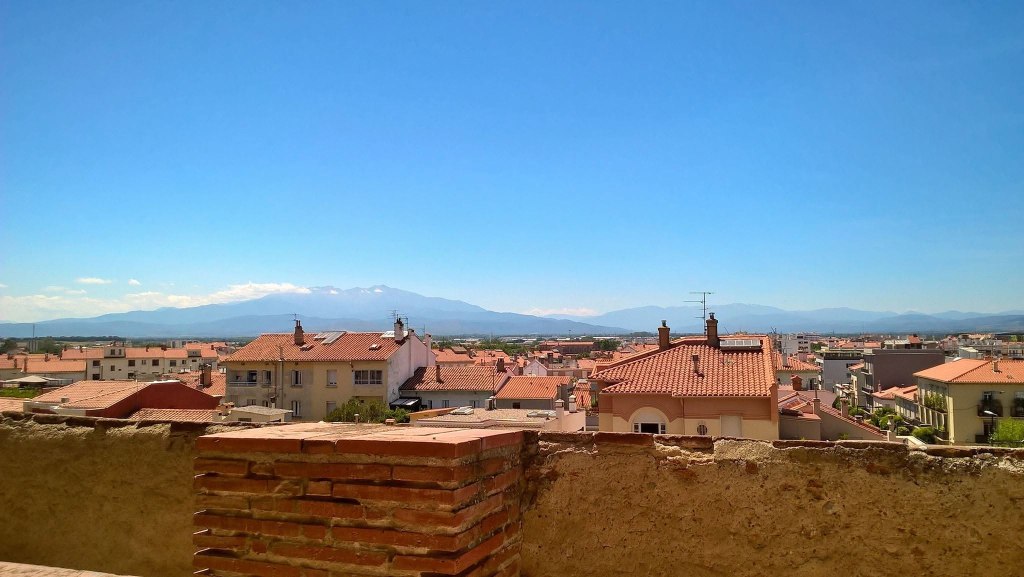
I have been to southern France once before. It was 10 years ago and long before I ever imagined I would write a novel set there. But, the landscape has stayed with me. I remember standing on the walls surrounding a 14th-century castle in the June heat and looking out at the sea of tiled roofs stretching out to suntanned farmland with the blue Pyrenees beyond. It was breathtaking.
At the time, I never thought I would write a novel about France, let alone Occitania. In fact, I don’t think I thought much about it at all after I came home. And yet, years later, when I began developing this story, I found myself returning to that landscape in my imagination.
But the landscape I remember is not quite the landscape Biatris, my protagonist, knows. The mountains are the same mountains. The rivers still run through the same valleys, and the sun still falls across some of the same stone walls. But almost everything else has changed. The fields are different. The roads are different. Even the way people understand the seasons and the natural world around them is different.
For Biatris, the landscape isn’t a place she has traveled to and admired. It is home. The roads and rivers are part of her daily life. Southern France’s seasons dictate the rhythm of her year. The mountains on the horizon are not a picturesque backdrop, but a familiar presence that has been there for as long as she can remember.
In my research for the novel, one of the particularly challenging things to uncover has been the movement of my characters through the landscape. I can see places on a map and imagine from my own time in France what the landscape between places looks like. I might even be able to imagine driving from place to place, but it’s difficult to grasp how it might have felt to ride a horse on hard pack roads between towns or to walk in 13th-century shoes along a pilgrim path. For this, I have had to look beyond modern maps and have instead turned to other medieval historical fiction as well as primary sources from the medieval period. In historical fiction about the medieval period, I have found that Sigrid Undset is particularly adept at talking about the realities and trivialities of travel — even if she is writing primarily about 14th-century Scandinavia.
Primary sources (things written as close to the time I’m studying as possible) are my main source of information, however. I’ve been reading accounts from medieval saints’ lives and other accounts to try and uncover the small things that turn history into something more tangible. One of my favorite recent rediscoveries (I’ve had the book since college) has been Margery Kempe’s descriptions of her travels around England. While she was dictating her book later in the medieval period than my story takes place, her descriptions of travel are priceless. There aren’t many details in them, but some, like her description of her and her husband carrying bread and ale on the road on a hot summer’s day and then stopping to rest below a roadside cross, start to give a sense of the humanity in history.
These are the sorts of details I am looking for as an author and that I live for as an historian. They don’t give me a complete picture of what travel in the medieval Languedoc felt like, and they certainly can’t tell me exactly what Biatris would have noticed or remembered. But they give me small glimpses of how an ordinary person might have experienced the world around them.
I can’t perfectly recreate that experience for my readers any more than I can perfectly recreate the language she spoke. But I can try to give them glimpses of it too. I can try to make the heat of a summer afternoon, the violence of a sudden afternoon storm, or the familiar shape of a mountain mean something more than scenery.
Perhaps that’s what landscape does in fiction, at its best. It doesn’t have to become a character in its own right. It just has to become part of the characters who live and move within it.
And, after all, isn’t that what places do to all of us?


Leave a comment